|
Hanchen Cui I am a Ph.D. student in computer science at the University of Minnesota Twin Cities, working with Prof. Karthik Desingh. I received my master's and bachelor's degrees from Shanghai Jiao Tong University and Xidian University, respectively. Previously, I was a researcher at Shanghai Qi Zhi Institute, where I worked closely with Prof. Yang Gao at IIIS, Tsinghua University. My research interest lies in robot learning and my long-term goal is to build a generalized robot that can accomplish long-horizon and complex tasks. To be more specific, I work on world models, vision-language-action models, and multimodal representation learning. In summer 2025, I interned at Meta FAIR, where I was fortunate to be mentored by Krishna Murthy Jatavallabhula and Franziska Meier and worked on action-conditioned world models and vision-language-action (VLA) models. In summer 2026, I interned at Amazon Robotics (Fauna Robotics team), where I worked with Roberto Martin-Martin and Luca Carlone. During the internship, I worked on sim-real co-training for VLA models, and latent world-action models (WAMs). Email: cui00191[at]umn.edu |

|
Publications* indicates equal contribution and † indicates joint last author. Representative work is highlighted. |
|
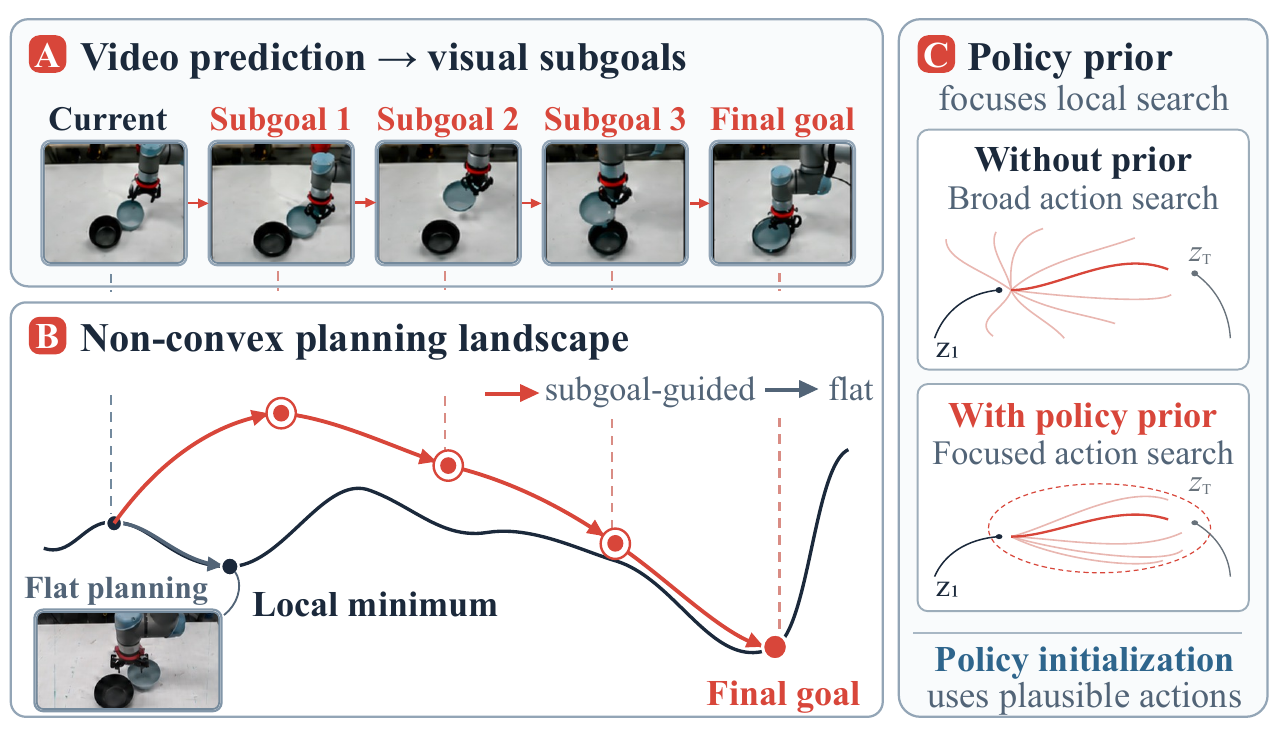
PILOT: Guiding Long-Horizon World-Model Planning for Robot Manipulation with Visual Subgoals and Policy Priors Yang Liu*, Hanchen Cui*, Karthik Desingh project page / arXiv We propose PILOT, which uses video-generated visual subgoals to guide long-horizon robot manipulation and policy priors to initialize world-model-based action optimization. PILOT achieves 68.8% success on real-world manipulation tasks, outperforming direct policy execution and improving planning efficiency. |
|
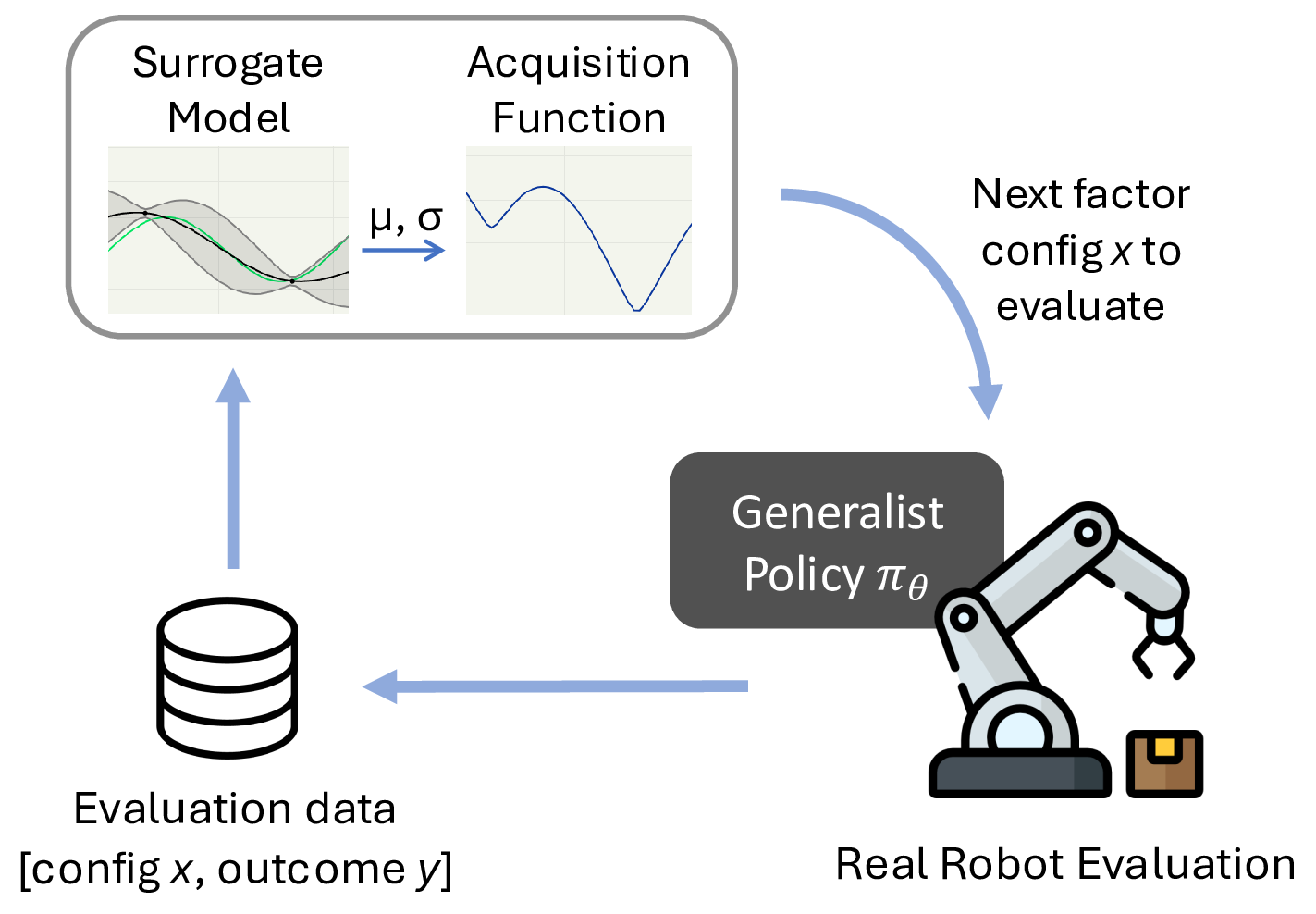
Active Real-World Factor-Based Evaluation for Generalist Robot Policies Andrew Liao, Hanchen Cui, Karthik Desingh, Aryan Deshwal arXiv We propose a Bayesian active evaluation framework that efficiently assesses generalist robot policies by adaptively selecting informative real-world test configurations. Across three manipulation tasks, our approach reduces evaluation trials by 20–40% compared to random testing while accurately characterizing policy generalization and identifying failure-prone conditions. |
|
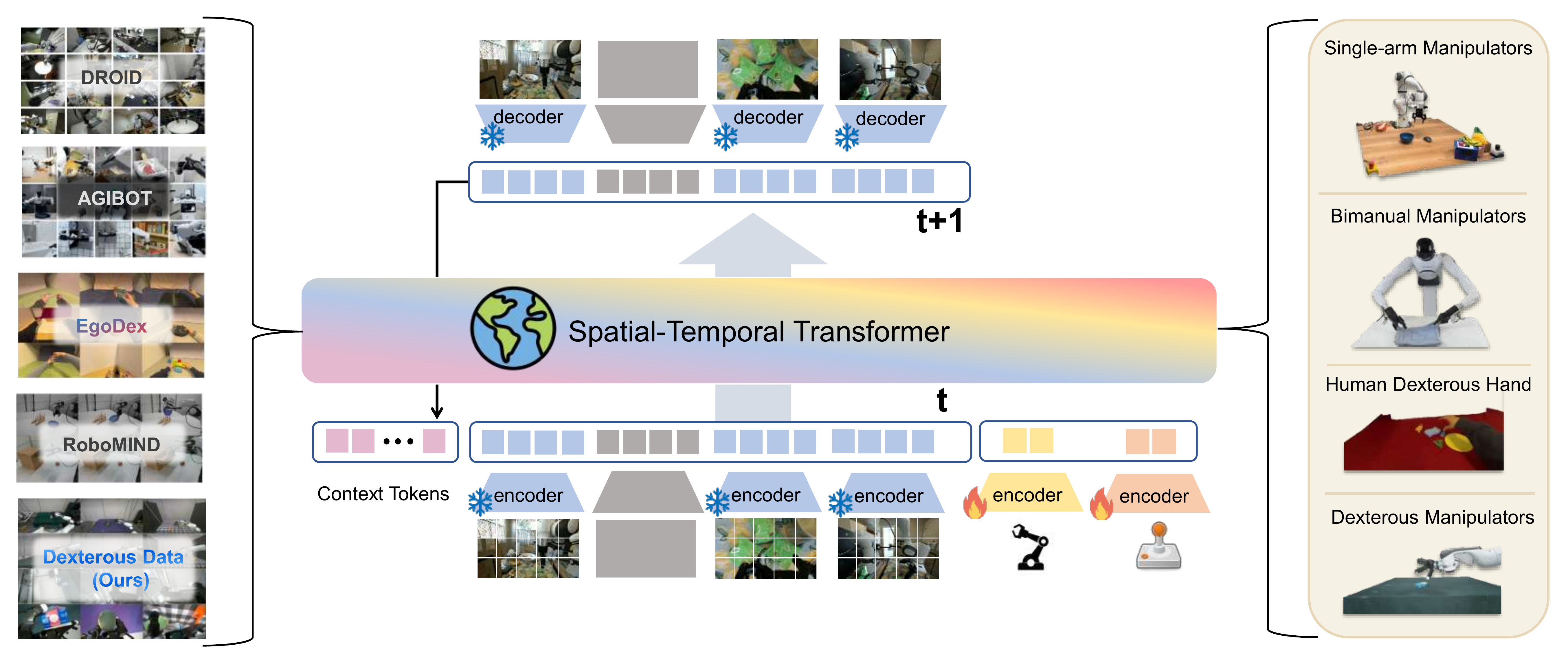
DREAMSTEER: Latent World Models can Steer VLA Policies during Deployment Without Any Finetuning Hanchen Cui, Sergio Arnaud, Arjun Majumdar, Daniel Dugas, Elie Aljalbout, Karthik Desingh†, Krishna Murthy Jatavallabhula† Franziska Meier† project page / arXiv We propose DREAMSTEER, a plug-and-play deployment-time steering framework that enhances pretrained VLA policies without any finetuning, or any in-domain data. By imagining candidate futures with a latent world model and ranking them with a value model, DREAMSTEER enables robots to select more reliable action sequences before execution. |
|
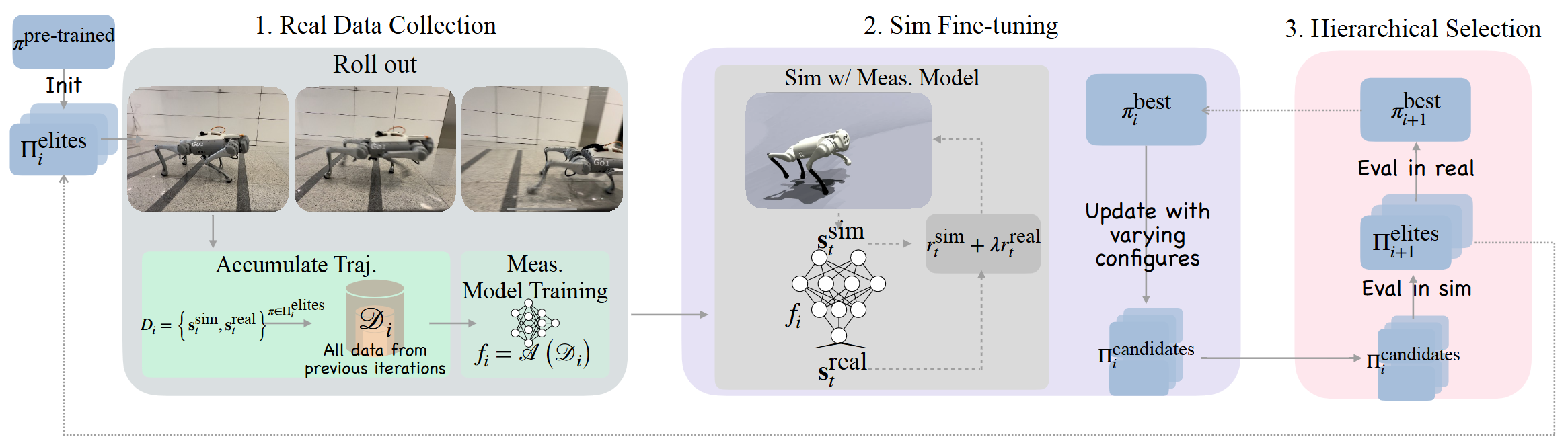
Fine-Tuning Hard-to-Simulate Objectives for Quadruped Locomotion: A Case Study on Total Power Saving Ruiqian Nai, Jiacheng You, Liu Cao, Hanchen Cui, Shiyuan Zhang, Huazhe Xu, Yang Gao ICRA 2025 project page / arXiv We propose a data-driven framework for fine-tuning locomotion policies, targeting these hard-to-simulate objectives. Our framework leverages real-world data to model these objectives and incorporates the learned model into simulation for policy improvement. |
|
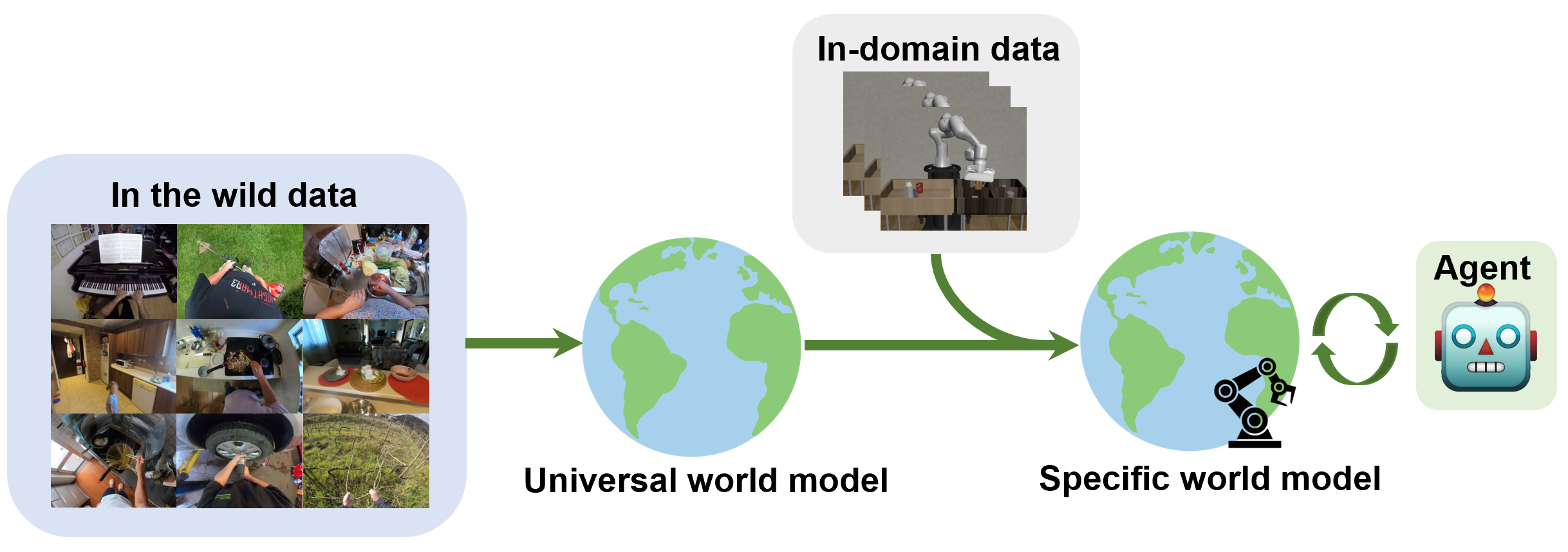
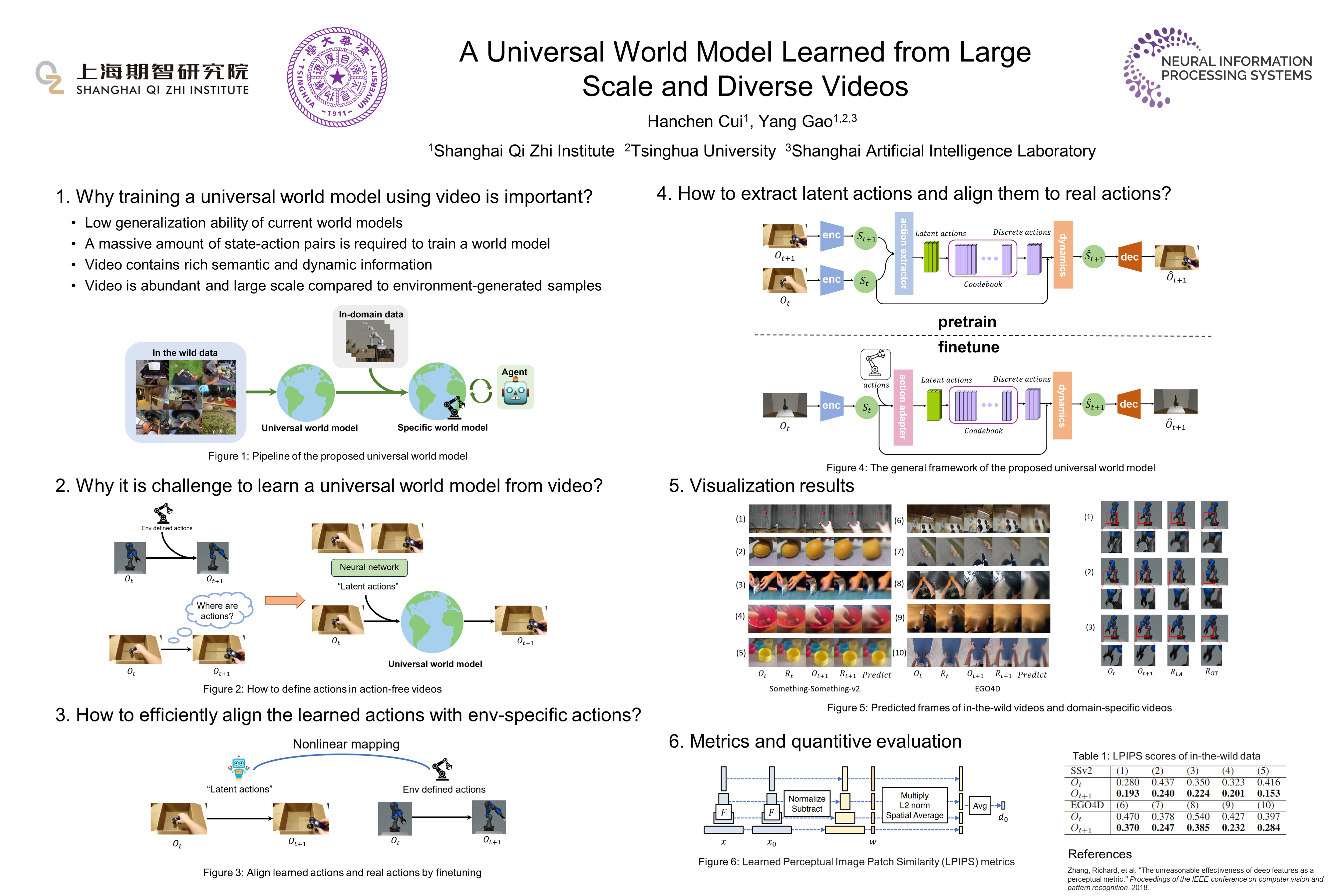
A Universal World Model Learned from Large Scale and Diverse Videos Hanchen Cui, Yang Gao NeurIPS 2023, Foundation Models for Decision Making Workshop paper / poster / code We propose a generalizable world model pre-trained by large scale and diverse video dataset using latent action extracted by VQ-VAE and then fine-tune the world model by robot data to obtain an accurate dynamic function. |
|
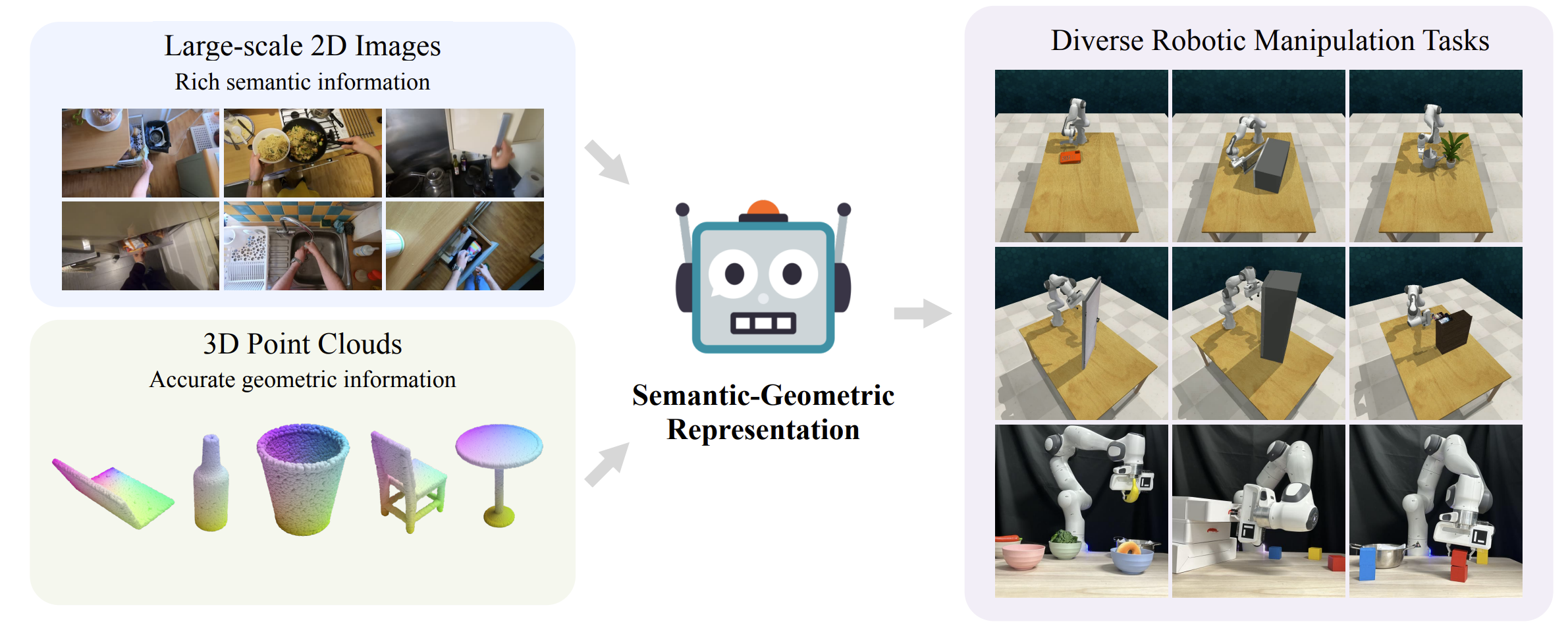
A Universal Semantic-Geometric Representation for Robotic Manipulation Tong Zhang*, Yingdong Hu*, Hanchen Cui,Hang Zhao, Yang Gao CoRL 2023 project page / arXiv / code We present Semantic-Geometric Representation (SGR), a universal perception module for robotics that leverages the rich semantic information of large-scale pre-trained 2D models and inherits the merits of 3D spatial reasoning. |
Research projects |
|
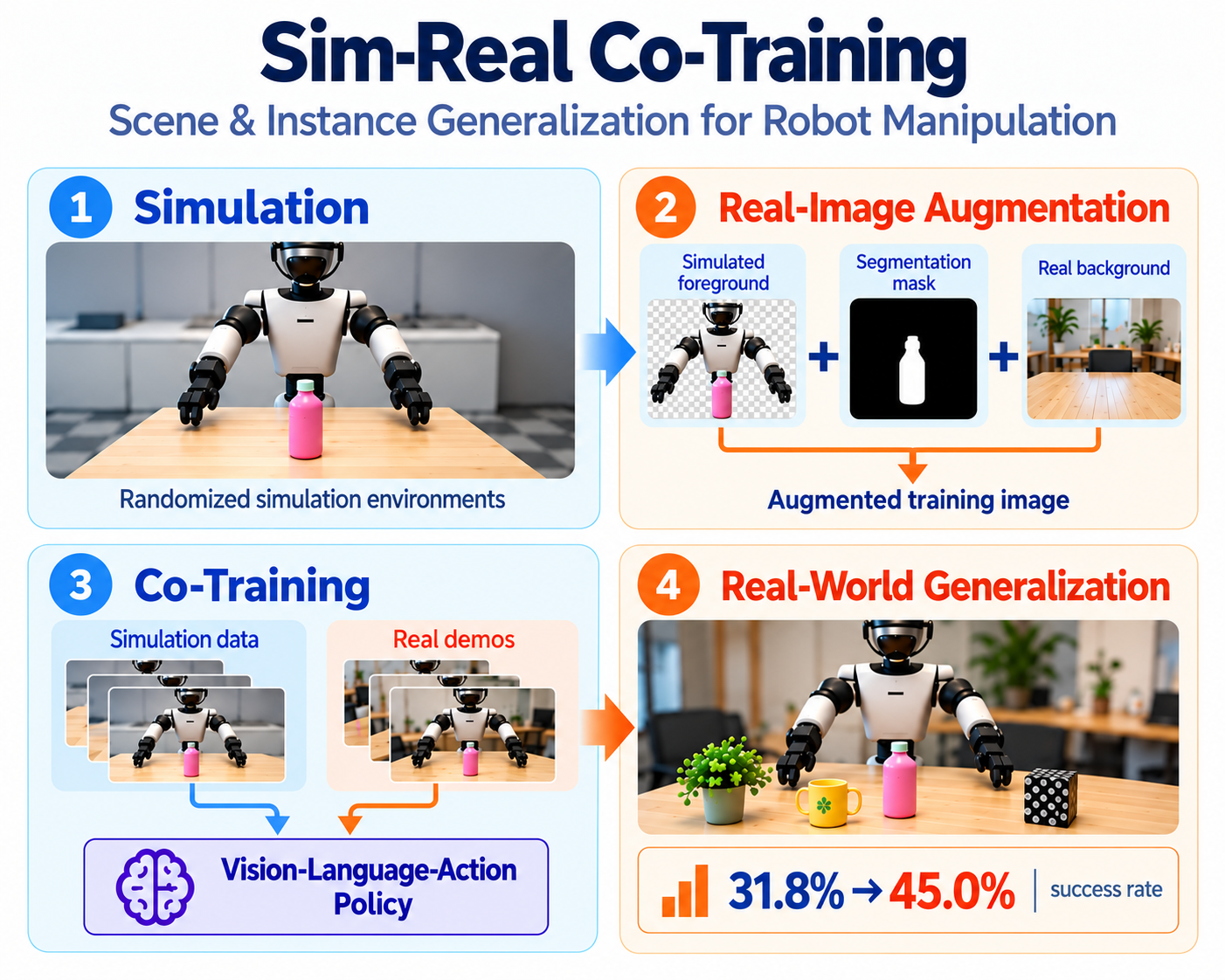
Sim-Real Co-Training for VLA models (1) Built a sim-real co-training pipeline for Unitree G1 manipulation using 3,000 simulation trajectories and real-world demonstrations. (2) Studied sim-to-real transfer and generalization by varying co-training ratio, simulation data scale, and domain randomization. (3) Proposed real-image-based simulation augmentation, improving real-world success rate from 31.8% to 45% in unseen scenes with distractors. |
|
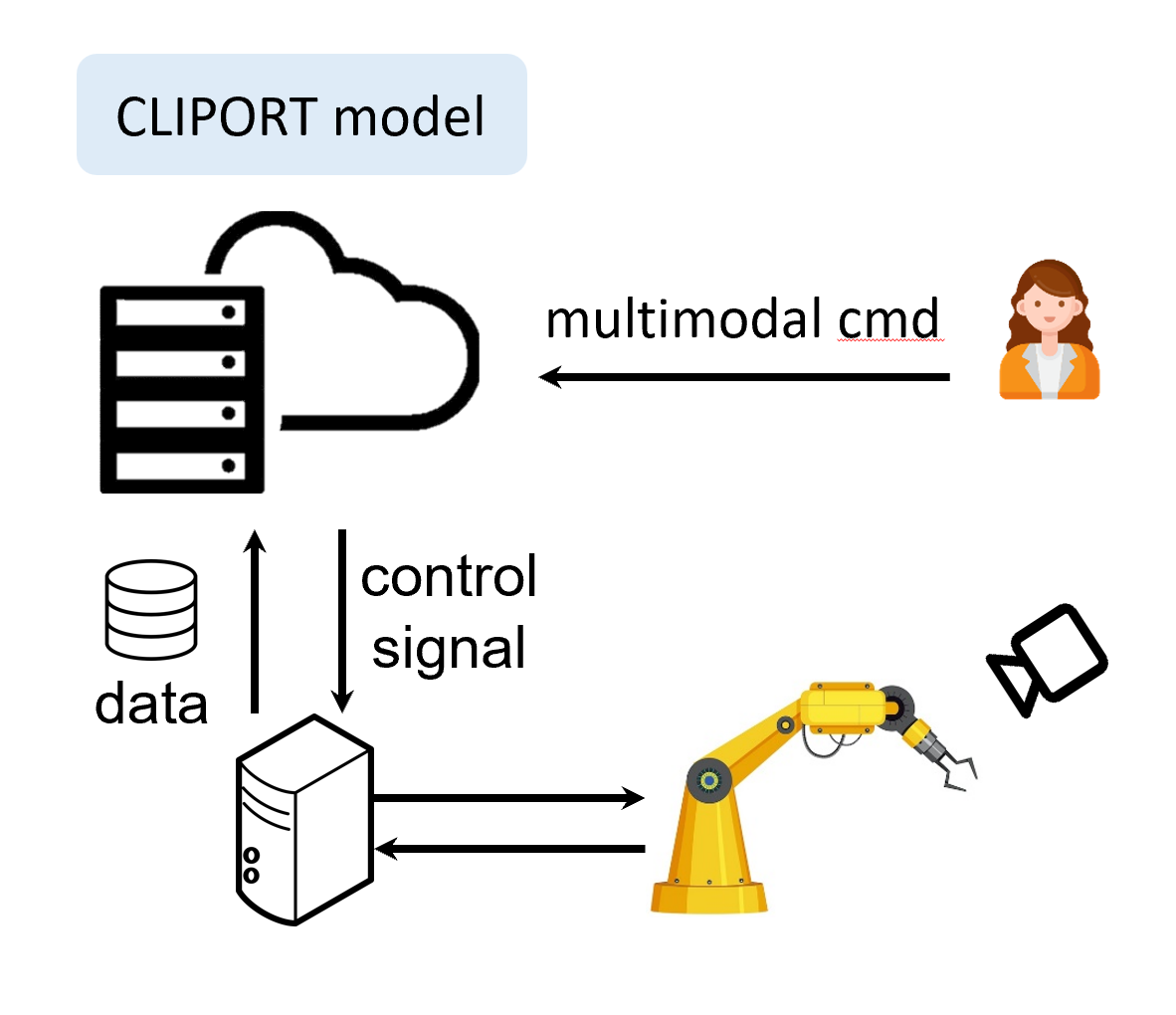
A real-time vision-language manipulation system (1) Build a vision-language manipulation deployment system to accomplish a variety of real world tasks based on Franka Panda Robot. (2) A robust client-server architecture is employed to enable low-latency remote control. (3) Fine-tune a vision-language manipulation model (CLIPORT), achieving 90% success rate in real-world experiments. |
|
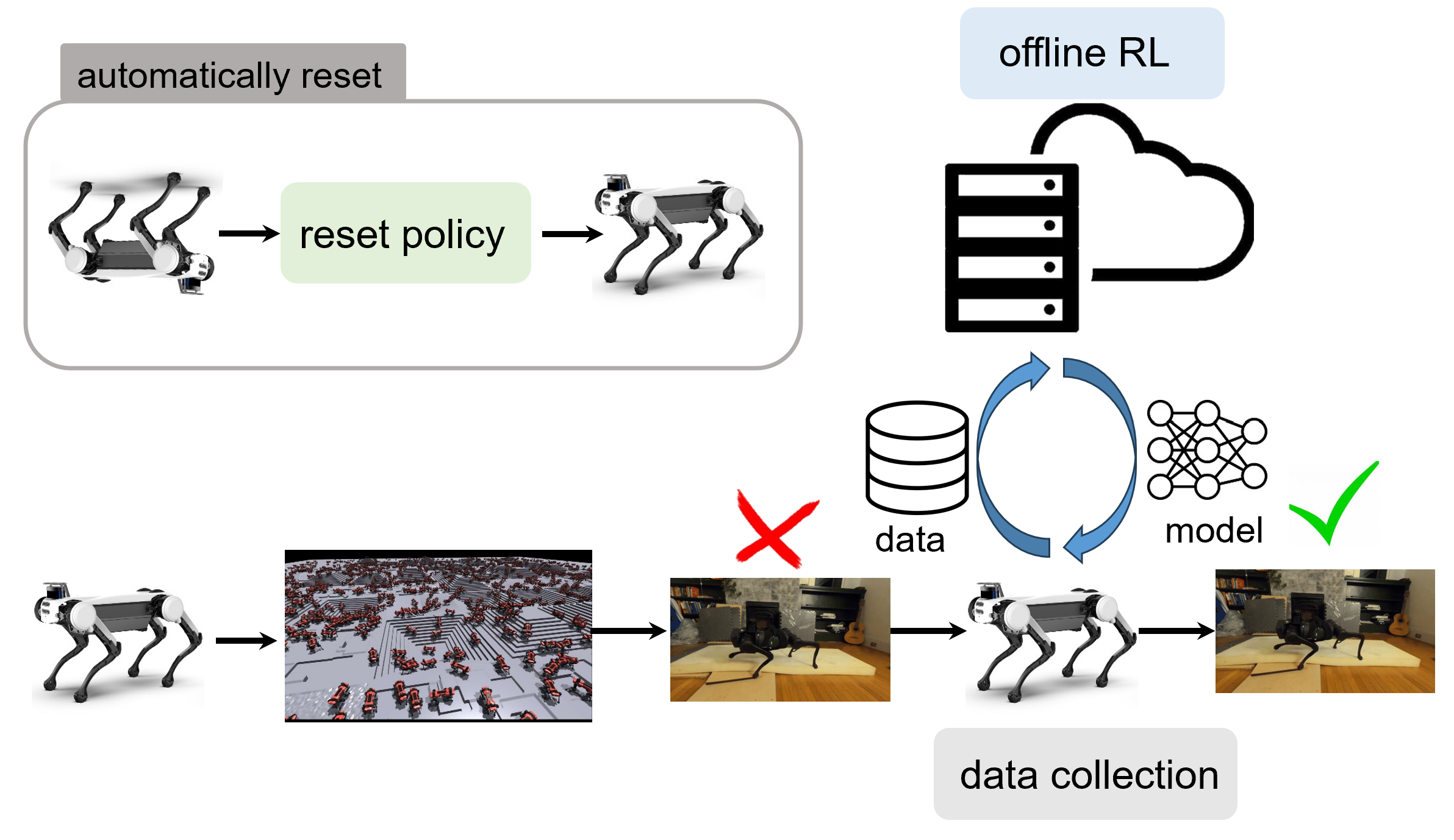
Legged robots learn from physical world (1) Establish a sim2real locomotion deployment codebase for legged robots. (2) Develop a real-world learning framework that acquires data from real-world interactions and performs policy training on a remote server. |
|
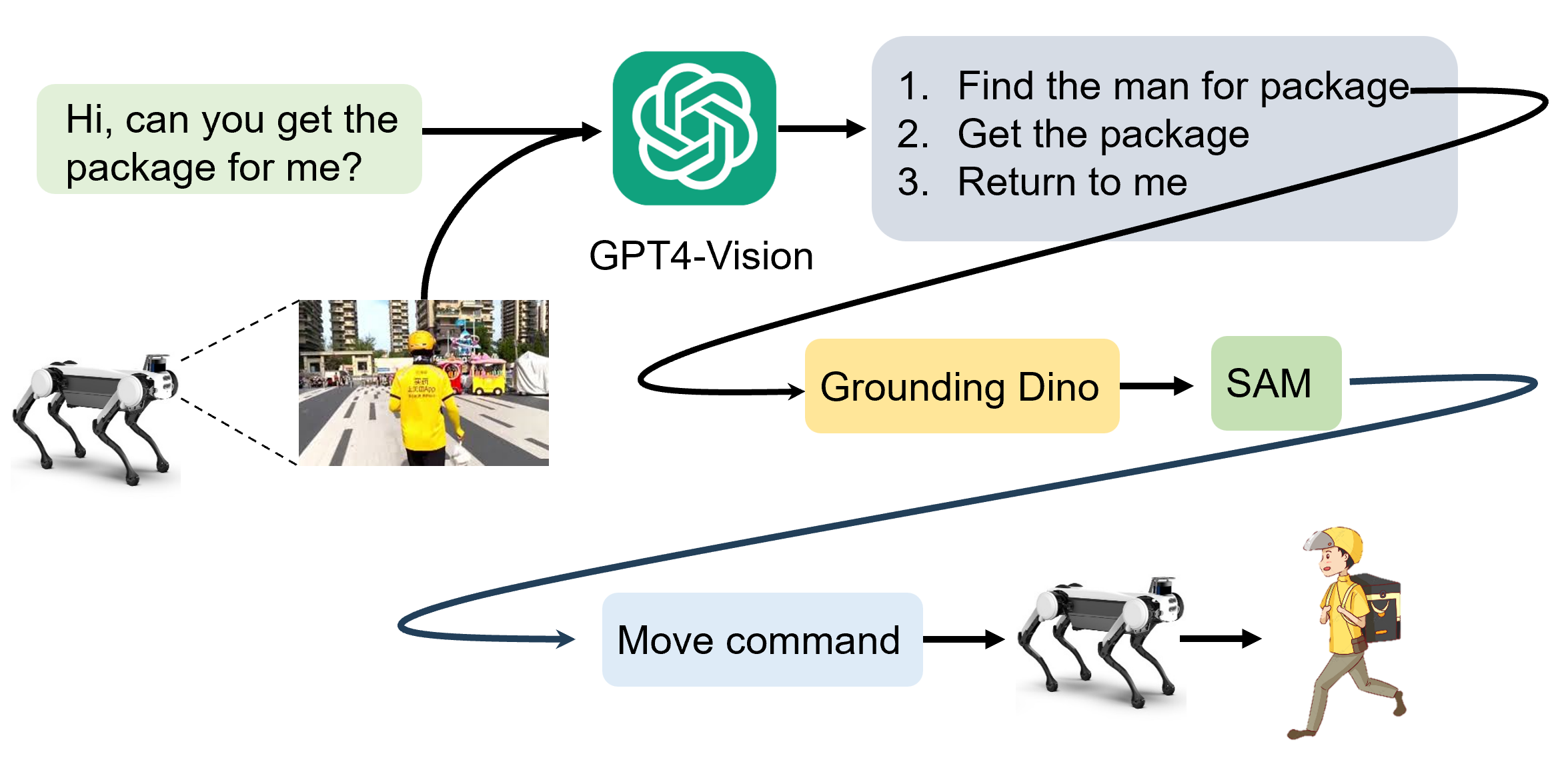
Visual planning for legged robots (1) Leverage the visual understanding and high-level planning abilities of large multimodal models (GPT4o), enabling legged robots to accomplish multi-step and complex tasks, such as sending packages, and objects retrieval. |
Services
|
|
Modified version of template from here. |